Patterns › The sixteen-pointed star
The sixteen-pointed star
Sixteen points on a circle, each joined to the sixth one along: a star with sharp 45° points.
Names
| English | sixteen-pointed star A plain description; pattern databases call it a regular 16-pointed star polygon.[1] |
|---|---|
| Arabic | name not documented No source found. If you know its name, tell us: hello@patternsouk.shop |
| Moroccan Darija | name not documented No source found. If you know its name, tell us: hello@patternsouk.shop |
Fez zellige makers name stars by their number of points: 'itnashari for 12, 'ishrini for 20, arba' wa 'ishrini for 24, and the so-called khamsini ("fifty") really has 48. Werner gives no name for sixteen, and we won't make one up.[2]
The Moroccan stars are recorded as regular sixteen-pointed stars with 45° points: the same figure as the one drawn below, whose points our code measures at 45°.[1]
Where it is found
- Marrakesh, the Saadian Tombs: in the zellige dado, a sixteen-pointed star between eight-pointed stars; another pattern there has two sixteen-pointed stars in each repeat.[1, 3]
- Fez, al-'Attarine madrasa: two patterns with a sixteen-pointed star; one of them is also at the tomb of Moulay Ismail in Meknes and on a Nasrid plaster panel from the Alhambra.[4, 5]
- Marrakesh, Ben Youssef madrasa: a sixteen-pointed star beside a twenty-four-pointed one.[6]
- Fez, the Bou Inaniya and Sefferine madrasas.[7, 8]
- Granada, the Alhambra: the Salón de Comares.[9]
- Dozens of patterns recorded in Morocco contain a sixteen-pointed star.[10]
Its geometry
Measured by our code from the figure it constructs below, not copied from a book.
| Star polygon | {16/6}: 16 points on a circle, each joined to the sixth point along |
|---|---|
| Outline | 32 equal sides |
| Angle at each point | 45° |
| Angle inside each notch | 292.5° |
| Notches / points (distance from the centre) | 0.6888 |
| Symmetry | 16 turns of 22.5° and 16 mirror lines (the dihedral group D16) |
| Pieces its 16 lines make | 81: one 16-sided centre, 16 triangles, 64 four-sided pieces, in 6 rings |
How to draw it with a compass and a ruler
Divide a circle into eight, halve every gap to get sixteen points, then join every sixth point. Every point comes from a crossing of lines and circles, and our code checks the finished figure against the exact one (to a billionth of the radius).
Step 1
Draw a circle and mark its centre. Rule a line through the centre: it meets the circle at two points.
Step 2
Open the compass wider than the radius. From each of the two points, draw an arc above and below.
Step 3
Rule a line through the two crossings. It passes through the centre at a right angle: four points.
Step 4
Set the compass to the radius. From each of the four points, draw arcs outside the circle: neighbouring arcs cross in four corners.
Step 5
Rule the two diagonals from corner to corner through the centre. They cut the circle at four more points.
Step 6
Eight points, exactly 45° apart: the starting point of every eight-fold star.
Step 7
Keep the compass at the radius. From each point, draw an arc outside the circle: arcs from neighbouring points cross between them.
Step 8
Rule a line from each crossing to the centre. Where it cuts the circle is a new point, halfway between two old ones.
Step 9
Sixteen points, 22.5° apart.
Step 10
From one point, rule a line to the sixth point along. Repeat from every point, always counting the same way.
Step 11
Go over the outer edge in ink, from point to notch to point. Erase every line inside and the circle.
Free printable: the steps and a line drawing to colour
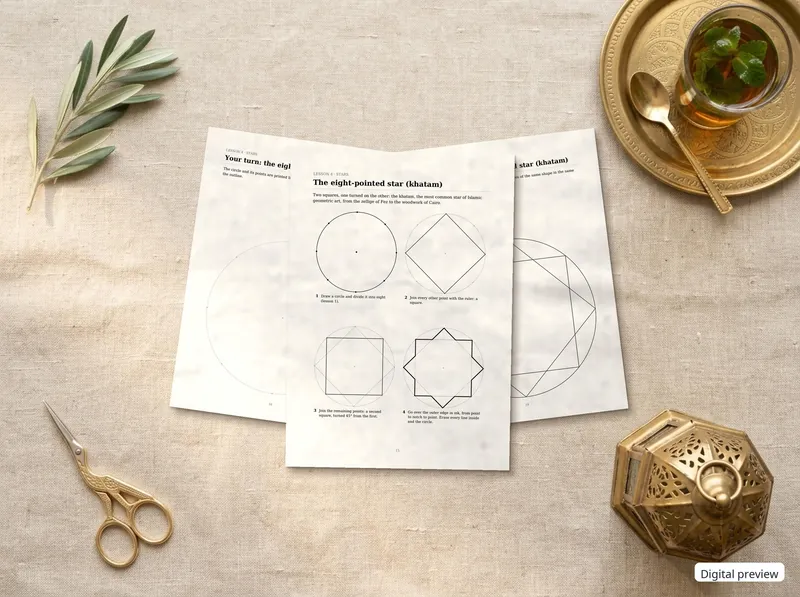
Two pages: these steps with their figures, and the finished the sixteen-pointed star as a line drawing to colour or trace. Free for personal and classroom use.
Download A4 (PDF) Download US Letter (PDF)Sources
- Tiling Search (B. Wichmann; MIT Libraries), pattern P76: zellij dado, Saadian Tombs, Marrakesh (from Degeorge and Porter, The Art of the Islamic Tile, p. 76). https://tilingsearch.mit.edu/HTML/data166/P76.html
- L. Werner, "Zillij in Fez", Saudi Aramco World 52:3 (2001). archive.aramcoworld.com
- Tiling Search (B. Wichmann; MIT Libraries), pattern P67: Saadian Tombs, Marrakesh. https://tilingsearch.mit.edu/HTML/data21/P67.html
- Tiling Search (B. Wichmann; MIT Libraries), pattern MOR0328: Attarine madrasa, Fez (David Wade photograph). https://tilingsearch.mit.edu/HTML/data189/MOR0328.html
- Tiling Search (B. Wichmann; MIT Libraries), pattern P97: Attarine madrasa, Fez; tomb of Moulay Ismail, Meknes; a Nasrid plaster panel from the Alhambra. https://tilingsearch.mit.edu/HTML/data21/P97.html
- Tiling Search (B. Wichmann; MIT Libraries), pattern MOR1237: Ben Youssef madrasa, Marrakesh (David Wade photograph). https://tilingsearch.mit.edu/HTML/data190/MOR1237.html
- Tiling Search (B. Wichmann; MIT Libraries), pattern BON11: Bou Inaniya madrasa, Fez. https://tilingsearch.mit.edu/HTML/data209/BON11.html
- Tiling Search (B. Wichmann; MIT Libraries), pattern MOR0406: Sefferine madrasa, Fez (David Wade photograph). https://tilingsearch.mit.edu/HTML/data190/MOR0406.html
- Tiling Search (B. Wichmann; MIT Libraries), pattern P141B: Salón de Comares, Alhambra, Granada. https://tilingsearch.mit.edu/HTML/data164/P141B.html
- Tiling Search, the patterns recorded in Morocco. tilingsearch.mit.edu/area/MORL.htm
How this page is made: the figures and every number in "Its geometry" are computed by our code and checked; names, places and history come only from the sources listed, and where we found no source we say so. Corrections are welcome: hello@patternsouk.shop.
Learn to draw these stars, free by email
Start with the eight-pointed star: a printable lesson with every compass step, a page to trace and a page to colour. A few short emails with the next lessons follow. Unsubscribe in one click.
We'll email you a confirmation link first.
Ready for all twelve lessons? Buy the workbook · $6 Workbook + 12 lesson videos · $12
Printable PDF, A4 and US Letter, an instant download. Checkout by Payhip.
Draw, color or crochet star patterns
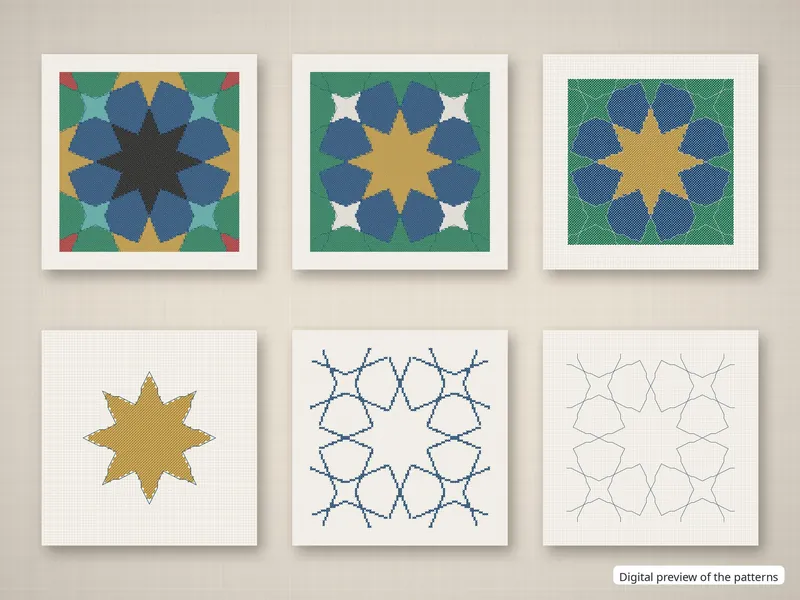
Digital files, sold on Etsy; personalised ones are made to order from your details. The pictures are digital previews.