Kufic script: the angular Arabic calligraphy of early Qur'ans and tiled walls
Kufic is the oldest surviving style of Arabic calligraphy used to write the Qur'an: tall, angular and horizontal, written with straight strokes and stretched letters. Long after it stopped being used for everyday writing, it kept its place on coins, pottery, tiles and the walls of mosques and palaces.
الخط الكوفي
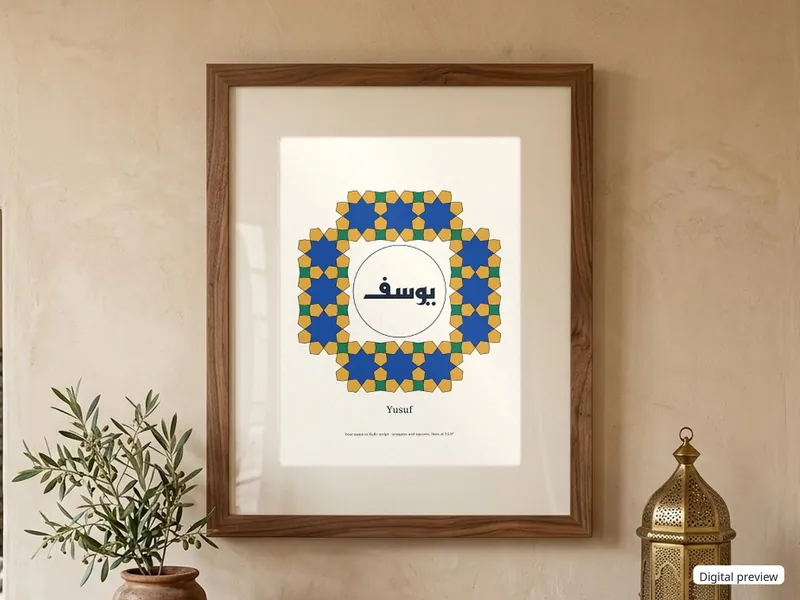
"al-khatt al-kufi", Kufic script, set in the modern Reem Kufi font
Where the name comes from
The script is named after Kufa, in Iraq, one of the early centres of Islamic learning, where it was once thought to have been developed (Britannica). Historians are less sure today: specialists such as François Déroche find "Kufic" too loose a label for the earliest Qur'an hands and speak of "Early Abbasid" scripts instead.
Kufic in early Qur'ans
The earliest surviving Qur'an copies, from the 8th to the 10th century, are mostly written in Kufic on parchment, in a wide horizontal format. Letters were stretched so that every line has the same length, and the small marks that tell letters apart were often left out: the reader was expected to know the text.
The most famous example is the Blue Qur'an, written in gold on parchment dyed indigo, with silver verse markers. The Met dates it to the late 9th to mid 10th century and places it probably in North Africa, possibly Qairawan in Tunisia, while noting that its origin is not settled (The Met). Another North African example, the "Nurse's Qur'an", was made in Qairawan around 1019–1020.
From about the 10th century, rounded cursive scripts such as Naskh gradually took over for copying the Qur'an. Their proportions were fixed by rule (a system credited to the vizier Ibn Muqla, who died in 940) and they are easier to read. Kufic went out of everyday use around the 12th century but never disappeared as decoration.
Decorated Kufic
Calligraphers and craftsmen made Kufic ornamental. In floriated Kufic, letters end in leaves and trefoils, as on 11th-century Iranian ceramics reading al-'izz, "glory" (The Met). Other styles braid or knot the tall letters together.
Square Kufic: lettering built into walls
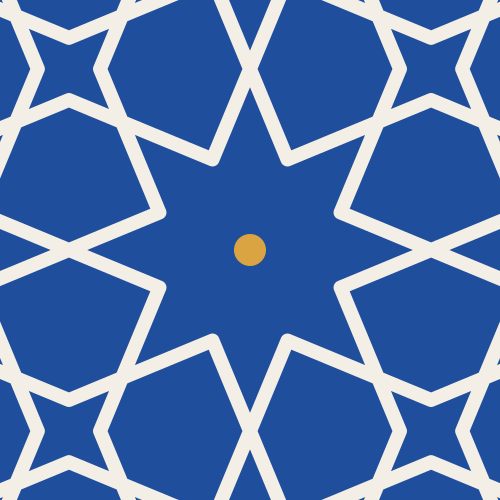
Square Kufic uses only straight lines and right angles, so it can be laid with square tiles or bricks: it grew up on buildings rather than on paper. The calligrapher and scholar Mamoun Sakkal traces early examples to Iran and Anatolia in the early 13th century and to Cairo in 1284, and whole facades in square Kufic to 15th-century Iran and Central Asia. In al-Andalus, the facades of the Alhambra mix rounded inscriptions with squared Kufic, and a Nasrid panel at the Met combines a Kufic inscription with a band of eight-pointed stars (The Met). Square Kufic is the reason Kufic and geometric patterns feel so close: both are drawn on a grid.
The font we use: Reem Kufi
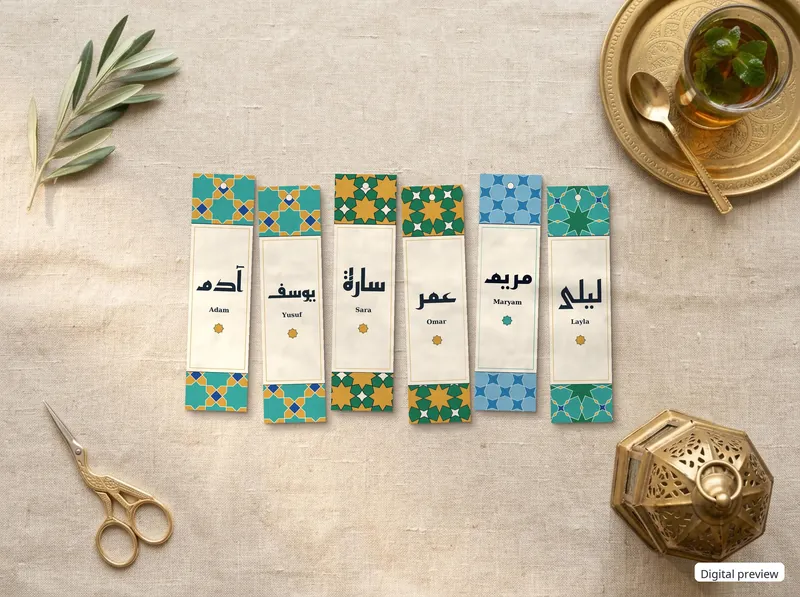
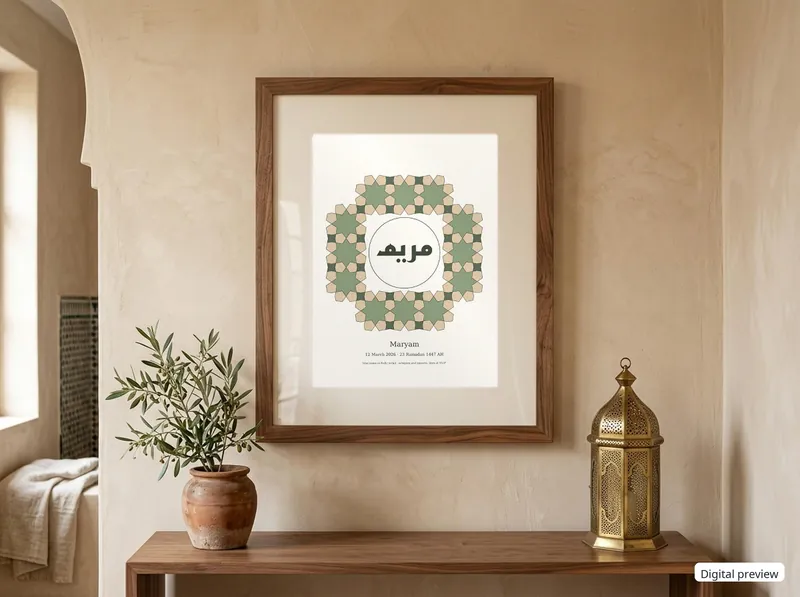
Our free Kufic name tool uses Reem Kufi, designed by Khaled Hosny, with Latin letters adapted from Santiago Orozco's Josefin Sans. In the designer's words it is based on early Kufic models, fitted to the Fatimid Kufic grid, and largely follows the 20th-century Kufic designs of Mohammed Abdul Qadir. It is a modern font in a Kufic style, not a copy of any historical inscription. Reem is an Arabic name meaning a white gazelle, and the name of the designer's daughter. The font is free under the SIL Open Font License (source).
A note on names in Arabic
Latin letters don't map one-to-one onto Arabic: one English spelling can match several Arabic ones (long or short vowels, ت or ط, س or ص, ه or ة), and families often have their own spelling. Before you print, engrave or stitch a name, check the Arabic with someone who writes that name in Arabic.
Write your name in KuficFree Ramadan 2027 pack, by email
Calendar pages with the Hijri date in every day, day 1 of our Ramadan stitch-along and three geometric coloring pages. One email to confirm, a few useful ones before Ramadan, unsubscribe any time.
Get the free packQuestions about Kufic script
What is Kufic script?
The oldest surviving style of Arabic calligraphy used to write the Qur'an: angular, horizontal and stately. It was also carved and painted on coins, tombstones, pottery and buildings.
Why is it called Kufic?
After Kufa in Iraq, an early centre of Islamic learning, where the script was once thought to have developed. The origin is not proven, and some specialists prefer the name "Early Abbasid" for the earliest Qur'an scripts.
How old is Kufic script?
The earliest Qur'an copies written in it date from the 8th to the 10th century. From about the 10th–12th century rounded scripts replaced it for everyday copying, but it lived on as decoration.
What is the difference between Kufic and Naskh?
Kufic is angular, with straight strokes and stretched letters. Naskh is a rounded, cursive and very legible script whose proportions were fixed in the 10th century; the system is credited to the vizier Ibn Muqla.
What is square Kufic?
A form of Kufic made only of straight lines and right angles, built into walls with glazed tiles or bricks. It is found on buildings in Iran, Central Asia, Anatolia, Egypt and Spain from around the 13th century.
Can I write my name in Kufic?
Yes: our free tool sets your name in Reem Kufi, a modern Kufic-style font, inside a zellige star. Arabic spellings of names vary, so check yours with someone who writes the name in Arabic before you print or stitch it.
Is the Reem Kufi font free?
Yes. It is published under the SIL Open Font License, which allows personal and commercial use; the only thing it forbids is selling the font file on its own.
Next: how to draw an eight-point star with a compass and ruler · design your own zellige star.
Your name in Kufic, ready to print
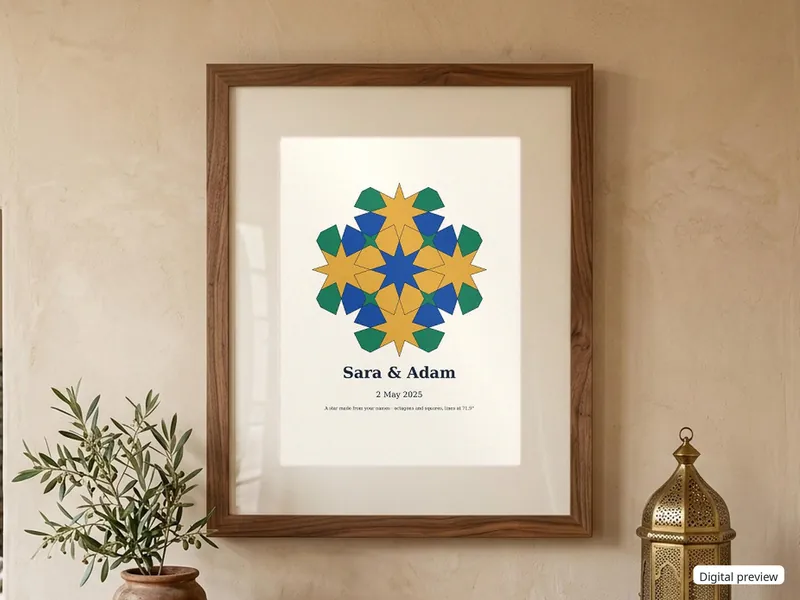
Digital files, sold on Etsy; personalised ones are made to order from your details. The pictures are digital previews.