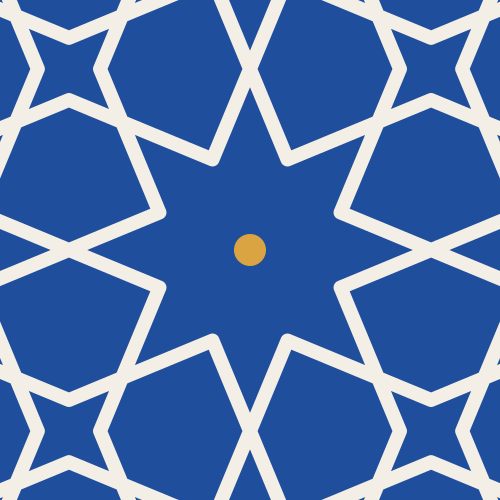
How to draw an eight-point star (khatam), step by step
The eight-point star is one of the most familiar shapes of Moroccan zellige and Islamic geometric art. You need only a compass, a ruler and a pencil. Below: the star in six steps, then how a whole pattern grows from a tiling by the polygons-in-contact method. Every figure on this page is computed by our pattern software, so the angles are exact.
Part 1: the eight-point star with compass and ruler
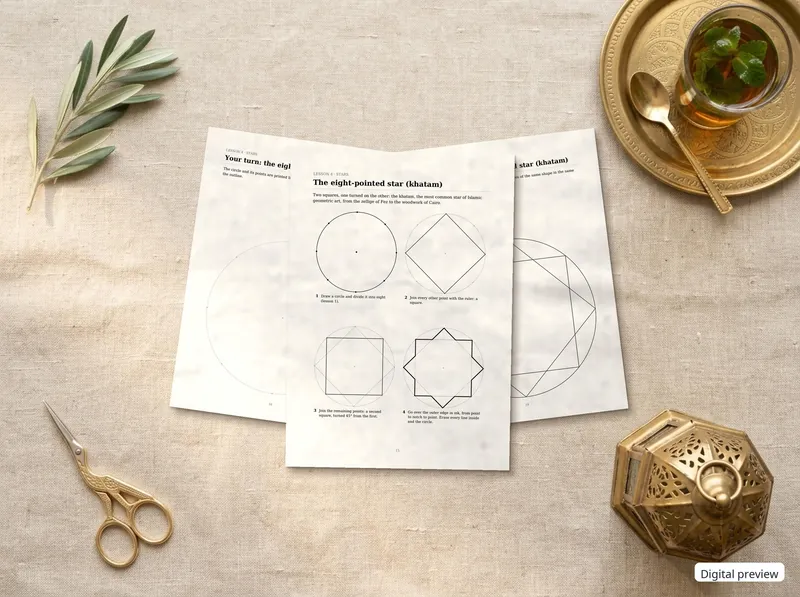
1. Draw a circle
Set your compass to the size you want the star to be and draw a circle. Mark the centre.
2. Divide it into four
Draw a horizontal and a vertical line through the centre, at right angles. They cross the circle at four points.
3. Divide it into eight
Bisect each right angle: the two diagonals cross the circle at four more points. You now have eight equally spaced points, 45° apart.
4. Join every other point
Connect the points at the top, right, bottom and left. This is the first square.
5. Draw the second square
Connect the four diagonal points. The two squares overlap, turned 45° from each other.
6. Trace the outline
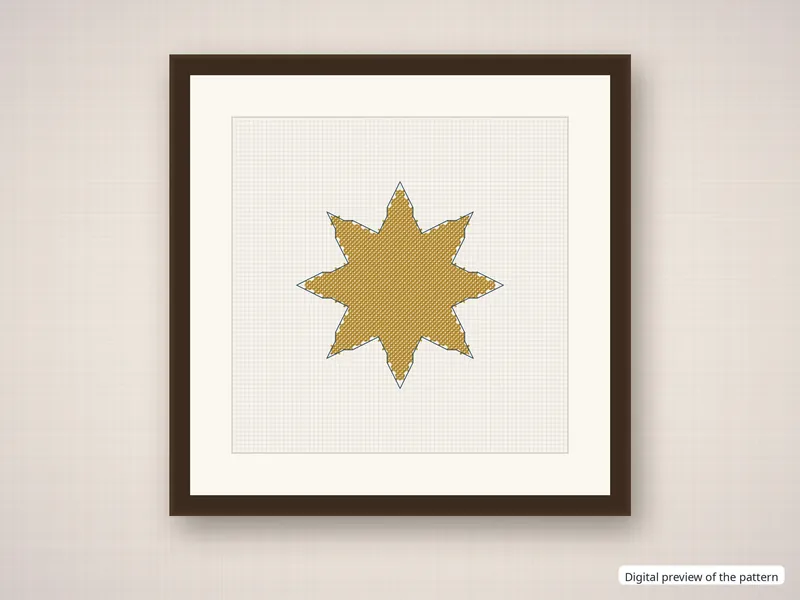
Follow the outer edge of the two squares and erase the lines inside. This is the eight-point star, the khatam, one of the most common stars in Islamic geometric art and Moroccan zellige.
Tip: draw lightly in pencil and ink only the final outline. For a sharper star, join every third point instead of every other one: that gives the "star of eight", with long thin points.
Part 2: from one star to a whole pattern
Real zellige patterns repeat across a wall. The classical way to build them is to start from a tiling and let lines cross at the middle of every edge.
1. Start from a simple tiling
Islamic star patterns are often built on a tiling of simple polygons. Here: octagons and squares, edge to edge.
2. Mark the middle of every edge
Every edge of every polygon gets a point at its middle.
3. Draw two lines through each midpoint
From each midpoint, draw two lines into the polygon at the same angle to the edge (here 67.5°), and stop each line where it meets a line from the neighbouring edge. This is the polygons-in-contact method, described by E. H. Hankin in the early twentieth century.
4. Remove the tiling and colour the pieces
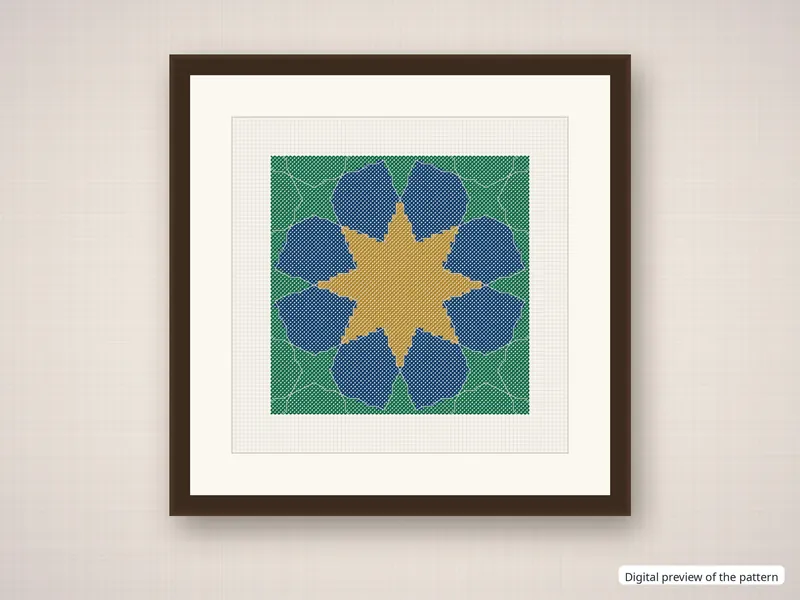
Erase the tiling: the lines form a star pattern of eight-point stars, petals and small stars. Change the angle and you get a different pattern from the same tiling.
Try it without a compass
Our free online Islamic geometric pattern generator builds these patterns for you: choose the tiling, change the angle, paint the pieces in real thread colours, and download a free cross-stitch chart.
Open the pattern generator See the patterns on EtsyAbout the eight-pointed star
Two squares and a circle
The Metropolitan Museum of Art lists the circle, the square, other polygons and "the ubiquitous star pattern" as the basic repeat units of Islamic geometric patterns, and describes the star as derived from squares and triangles inscribed in a circle. The regular eight-pointed star is exactly that: two equal squares in one circle, one turned 45°. It has sixteen equal sides and a right angle at every point, which is why it tiles so well with crosses and octagons. These shapes were already known in late antiquity; artists in the Islamic world developed them into whole systems of pattern (The Met).
Why it is called a khatam
Khatam (or khatim) is Arabic for a seal or signet ring. Pattern-makers writing in English often call the regular eight-pointed star a khatam. In the workshops of Fez, one report from 2001 heard the star-shaped tile pieces called dirhams, and stars named by their number of points (Louis Werner, Saudi Aramco World, 2001).
The ۞ sign in the Qur'an
In many printed copies of the Qur'an, a small eight-pointed sign, ۞, marks where each quarter of a hizb begins. The Qur'an is divided into 30 juz', each juz' into two hizb and each hizb into quarters. The sign is called rub' al-hizb ("quarter of the hizb"); its basic form is two overlapping squares, and Unicode encodes it as U+06DE. It is a reading aid for dividing the text, not a statement about what the star means.
Where to see it
- Kashan, Iran, 13th century: wall panels of eight-pointed star tiles and cross tiles in lustre, some carrying Qur'anic verses and others Persian poetry (The Met).
- Granada, late 13th–14th century: a Nasrid limestone panel with a band of repeating eight-pointed stars and a Kufic inscription (The Met), and the tile dados of the Alhambra's Comares Palace, completed under Muhammad V in 1370.
- Fez, 14th century: the zellige dados of the Marinid madrasas, al-'Attarin (1323–1325) and Bou Inaniya (about 1350–1355).
What does it mean?
There is no single, documented meaning. The Qur'an does not define the shape, and historians such as Gülru Necipoğlu (The Topkapı Scroll, 1995) warn against reading one timeless symbolism into Islamic geometric ornament. What museums do say is that these patterns "stressed the importance of unity and order" and, in their repetition, offer "the possibility of infinite growth" (The Met). You may read meanings into it that matter to you; we simply don't claim one as fact.
Free Ramadan 2027 pack, by email
Calendar pages with the Hijri date in every day, day 1 of our Ramadan stitch-along and three geometric coloring pages. One email to confirm, a few useful ones before Ramadan, unsubscribe any time.
Get the free packQuestions about the eight-pointed star
What does the eight-pointed star mean in Islam?
There is no single documented meaning: the Qur'an does not define the shape, and historians warn against reading one timeless symbolism into Islamic geometric ornament. Museums describe these patterns as decoration that stresses unity and order and can repeat without end.
What is the ۞ symbol in the Qur'an?
It is the rub' al-hizb sign. In many printed copies of the Qur'an it marks where each quarter of a hizb begins (the Qur'an is divided into 30 juz', each of two hizb). In Unicode it is U+06DE.
Why is the eight-pointed star called a khatam?
Khatam is Arabic for a seal or signet ring. Writers on Islamic patterns often use it for the regular eight-pointed star, but it is a pattern-makers' name rather than an official one.
How do you draw an eight-pointed star with a compass and ruler?
Draw a circle, inscribe a square in it, then a second square turned 45 degrees. The outline of the two squares is the star. The six steps are at the top of this page.
Where can I see eight-pointed stars in Islamic art?
For example in 13th-century lustre star tiles from Kashan in Iran, in Nasrid stone and tile work in Granada and the Alhambra, and in the zellige of the 14th-century Marinid madrasas of Fez.
Which flag has an eight-pointed star?
The flag of Azerbaijan has a white eight-pointed star beside a crescent. The star on Morocco's flag has five points.
Next: more stars and whole patterns, step by step · why tiles fit: tessellations · Kufic script, the angular Arabic lettering of early Qur'ans and tiled walls · free eight-point star garland to print.
Learn to draw these stars, free by email
Start with the eight-pointed star: a printable lesson with every compass step, a page to trace and a page to colour. A few short emails with the next lessons follow. Unsubscribe in one click.
We'll email you a confirmation link first.
Ready for all twelve lessons? Buy the workbook · $6 Workbook + 12 lesson videos · $12
Printable PDF, A4 and US Letter, an instant download. Checkout by Payhip.
Make your own eight-point star
Digital files, sold on Etsy; personalised ones are made to order from your details. The pictures are digital previews.